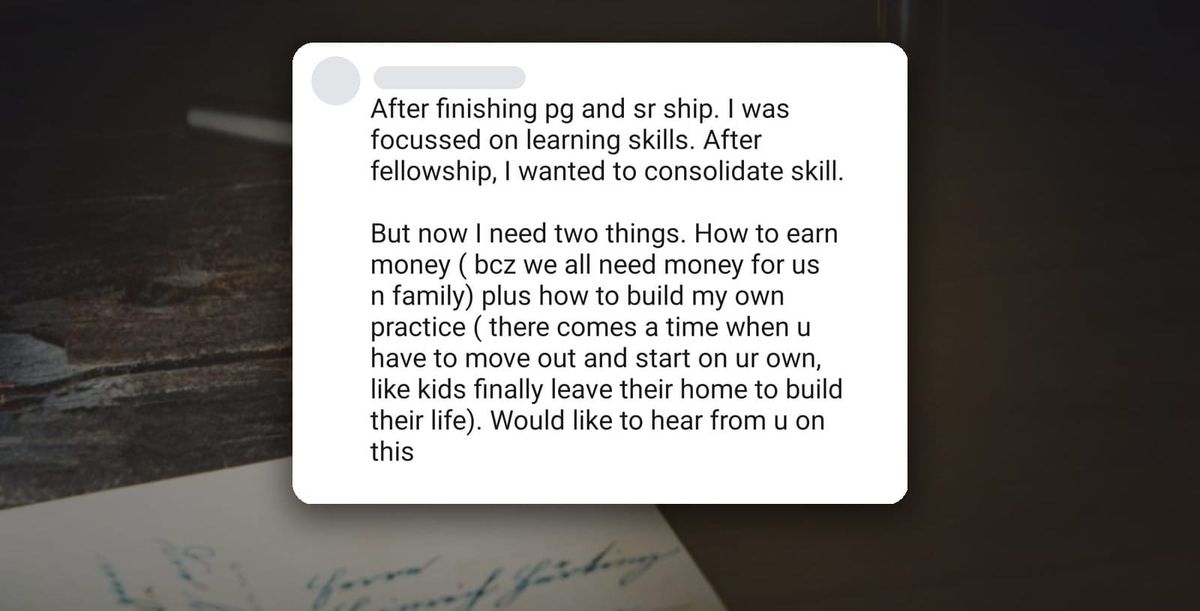
Dear friend,
You wrote to me recently, and I have been carrying your message around ever since. You said you spent your PG years and senior residency learning the skill, your fellowship consolidating it — and now you need two things from me. How to earn money, because we all need money, for ourselves and for the people who depend on us. And how to build a practice of your own, because — these are your words, and they are better than anything I could have written — there comes a time when you have to move out and start on your own, like kids finally leaving home to build their life.
I read that line three times. You already know the answer. Children leave. That was never really your question. What you are asking for is a map of the first years — and underneath it, in the part of the message you didn't type, a blessing. Someone older, saying: yes, go, you will survive it.
So let me write you the whole letter. The map and the blessing. I stood exactly where you are standing, and nobody wrote this to me.
First, let me tell you what leaving home actually looks like, because nobody describes it honestly.
After my own training I joined a corporate hospital and was folded straight into my senior's unit — a busy hip and knee practice. Those were warm years. I never had to look for a patient; the unit was full before I woke up. I took histories, sat with patients who had flown in from other countries, listened to their stories, assisted, learned. People kept asking me, "Why aren't you starting your own practice?" I never felt the need. I was protected, and the protection was real and kindly meant. But I will tell you what I could not see then: the warmth of a busy senior's unit quietly postpones a reckoning. It does not cancel it.
In 2010 I became a consultant, on my senior's own recommendation. And here is the detail I want you to sit with. I was given the exact same room he used to sit in. The same chair, the same desk, the same door that patients had queued outside for years. I opened my account, as we say. And nobody came.
The room that was crowded for him was empty for me. Day after day. I cannot dress this up for you — it was a shock. After years inside a full unit I felt very empty from inside. It made me question my ideals and my capabilities, both at once. Outwardly I kept my face composed; inwardly I was literally begging for a patient. It took patience, and a lot of convincing from my own self, to keep sitting in that chair.
But that empty room taught me the single most useful thing I know about building a practice, and I am handing it to you now so you don't spend your first year misreading it. The queue was never attached to the room. It was not attached to the hospital's name on the gate, or to the chair, or to the desk. It was attached to a man, and it had been built over years, one patient at a time. When you move into any room — his, or your own — you inherit the furniture, not the trust.
So expect the empty room. It is not a verdict on your hands. It is simply where everyone who leaves home begins.

Now, how the room filled. Because it did fill, and the way it filled is the honest answer to your second question.
The first patients were innocent-looking walk-ins. No referral letters, no connections, nobody sent by anybody. I was a nobody, but they trusted me based on what I said and the way I spoke. I am still grateful to those people. They went under my knife on trust alone, and I have never forgotten what that cost them to give.
It took me years to see the mechanism clearly, and it is embarrassingly simple: honesty. There is a standing temptation for every young surgeon in that empty room, and you will feel it within your first month. When a patient asks how many of these you have done, there is no register anyone can check. You can claim any number you like. Every instinct in you — fear, ambition, the empty appointment book — says inflate. I refused. I gave realistic numbers, small ones, and watched patients absorb them. And over the years the same feedback kept returning, in almost the same words: "You are the only guy who gave us a realistic number." Patients cannot audit your surgical logbook, but they can smell inflation. Honesty in a young surgeon is so rare it works like advertising.
Here is the part no one told me about those first walk-ins. They are still my patients today. Fifteen years on, they are still in touch — their knees, their parents, their neighbours. In our part of the world a practice is not a funnel of strangers; it is a set of relationships measured in decades. Which means your first ten patients are not revenue. They are foundation stones. Treat them accordingly.
One day, when the room has begun to fill, we can talk about the finer mechanics — how patients decide in the first seconds, what a consultation fee actually does. I have written those letters already, in their way. For today, hold only this: the practice is built on trust, trust is built on honesty, and honesty compounds for decades.
Your first question — money — deserves the same honesty, so let me give you my actual numbers instead of principles.
My first salary was about ₹9,500 a month. Rent was ₹4,500. Half the month gone before it began. My wife and I scraped through those years — and we still saved. I want you to read that twice, because it is the whole discipline in one sentence. Saving is not something you begin when the amount becomes respectable. You begin when it is laughable, because what you are building is not a balance. It is a habit.
In those lean years I never compared my salary with anyone else's, or with what a surgeon "should" earn. I held on to one question only: is my salary today better than what it was yesterday? As long as the answer was yes, I kept my head down and kept learning, because at that stage your skill is compounding faster than your money ever could. And the answer kept being yes — my senior doubled my salary within six months without my asking, kept raising it, and within about five years I had crossed a lakh a month. The income followed the learning. It usually does, though nobody promises you the schedule.
Then there is the evening I think of as the luckiest accident of my career. I used to stop at the railway station magazine stand and buy computer magazines — every time, same shelf. One evening, for no reason I can reconstruct, I picked up a mutual fund magazine instead. That accidental purchase introduced me to systematic investing, and it changed everything that came after. Before that I had done what every young doctor does: bought two insurance policies dressed up as investments, for the tax benefit, and got pathetic returns and inadequate cover for my trouble.
What I settled into was simple enough to survive a surgeon's life: 25 to 30 percent of everything I earned went into SIPs every month, diversified, no cleverness. I started right around 2008 — yes, into the crash. I watched the market fall and kept the instalments going, and within a year the market recovered and my discipline looked like magic. It was not magic. It was discipline multiplied by time, which is the only market strategy available to a person who spends his days in an operation theatre and cannot study charts. Later I moved towards index funds and simplified further.
And here is what the money was actually for. Not the car — I rode a two-wheeler for years while colleagues upgraded, and I bought nothing on impulse, and I felt no poverty in any of it. The savings were for one specific freedom: when a crisis came, including a medical one in my own family years later, I could dip into my savings without having to look at somebody else for the money. That is the entire purpose of a buffer at your stage. Not status. Sovereignty.
If none of this was taught to you, that is not your failure. Researchers once gave residents and fellows a basic personal-finance test; they averaged roughly half marks. A whole generation of us graduates financially untaught. You are not behind. You were simply never taught, and now you are teaching yourself, which is why you wrote to me.
Money became something I could handle, rather than it handling me. That sentence took me fifteen years. I am giving it to you in one.

Now the part your message did not ask, which is the real reason I am writing at this length. The fear.
When I finally stood alone, the fear was about everything. What if the joint gets infected. What if it goes stiff. What if the patient is angry, what if a case is filed, what if I lose face in front of the very people who recommended me, what if the hospital regrets giving me the room. All the wrong things were sitting in front of me and staring down at me, but the positive things were not. Only the catastrophes attended, punctually, every night.
I know the name of that enemy now. Negativity bias. The mind gives the worst outcomes the front row and keeps the likely ones standing outside. The fear itself is real — I will not insult you by calling it irrational — but it is miscalibrated. With good training, good selection, and good care, the negative comes rarely. What was overwhelming me and killing me in those first years was not complications. It was the bias. Overcoming it is not a mood; it is deliberate work, and you should treat it as seriously as you treated your fellowship.
I found my own method outside the hospital entirely. I took up running, and I kept signing up for distances I had no business attempting. Every distance I broke turned out to be an artificial barrier the mind had built, and every barrier that fell in running fell somewhere in my practice too. I began taking on cases I had never done — some I had never even seen my senior do — and doing them well, with the majority of my patients happy. The courage transfers. Do difficult things anywhere in your life, and the operation theatre collects the dividend.
Let me end this section with a phone call, because it is the closest thing I have to proof.
A young surgeon I know rang me one night, restless, almost breathless. He had done his first knee replacement — a milestone you will remember forever, as I remember mine — and then discovered, post-operatively, that the patient had a urinary tract infection. In his head the sequence was already complete: UTI, seeded joint, infected implant, ruined patient, ruined career. I let him finish. Then I told him what an older voice should have told me in my empty room: a UTI does not mean the knee will get infected. Evaluate it, treat it, watch for the signs, and go back to bed. He slept.
All he needed was assurance.
I put the phone down that night and understood something that has stayed with me since. In that moment I had become the sender of the letter I never received.
So consider this letter the same phone call, made to you in advance. The fear you are about to feel is real, and it deserves a hand on the shoulder, and here is mine.
So let me answer your metaphor properly, the way it deserves.
Yes. Kids finally leave their home. That is not a betrayal of the house — it is what the house was for. Your training gave you the hands. The busy unit gave you shelter while the hands matured. Neither one can give you the trust; that you must build yourself, patient by patient, honest number by honest number, in a room that will be emptier than you expect for longer than you would like.
So: go. Expect the empty room and do not read it as a verdict. Tell the truth about your numbers when every instinct says inflate. Save a fixed share of your income before you feel rich enough to save. Do difficult things outside the theatre so you have courage to spend inside it. And when the fear lines up its catalogue at 2 AM — and it will — remember the one thing I know for certain from the far side of it:
The negative is always louder in your head than it will ever be in your life. Go and build your house.
Yours,
Biswajit
P.S. — Surgeons have written letters like this before me. Richard Selzer wrote a whole book of them, Letters to a Young Doctor, and long before him Rilke told his young poet to stop demanding answers and live the questions themselves. I hold to the same spirit. You do not need every answer before you begin. Begin — and the answers will arrive the way patients do. One at a time.
Further Reading
1. Letters to a Young Poet — Rainer Maria Rilke (1903-1908 letters; pub. 1929)
2. Letters to a Young Doctor — Richard Selzer (1982)
3. Aequanimitas, with Other Addresses to Medical Students, Nurses and Practitioners of Medicine — William Osler (1905)
4. Generational trends underlie doctors' move from private practice — American Medical Association (2023)
5. An assessment of residents' and fellows' personal finance literacy: an unmet medical education need — Ahmad et al., International Journal of Medical Education (2017)