
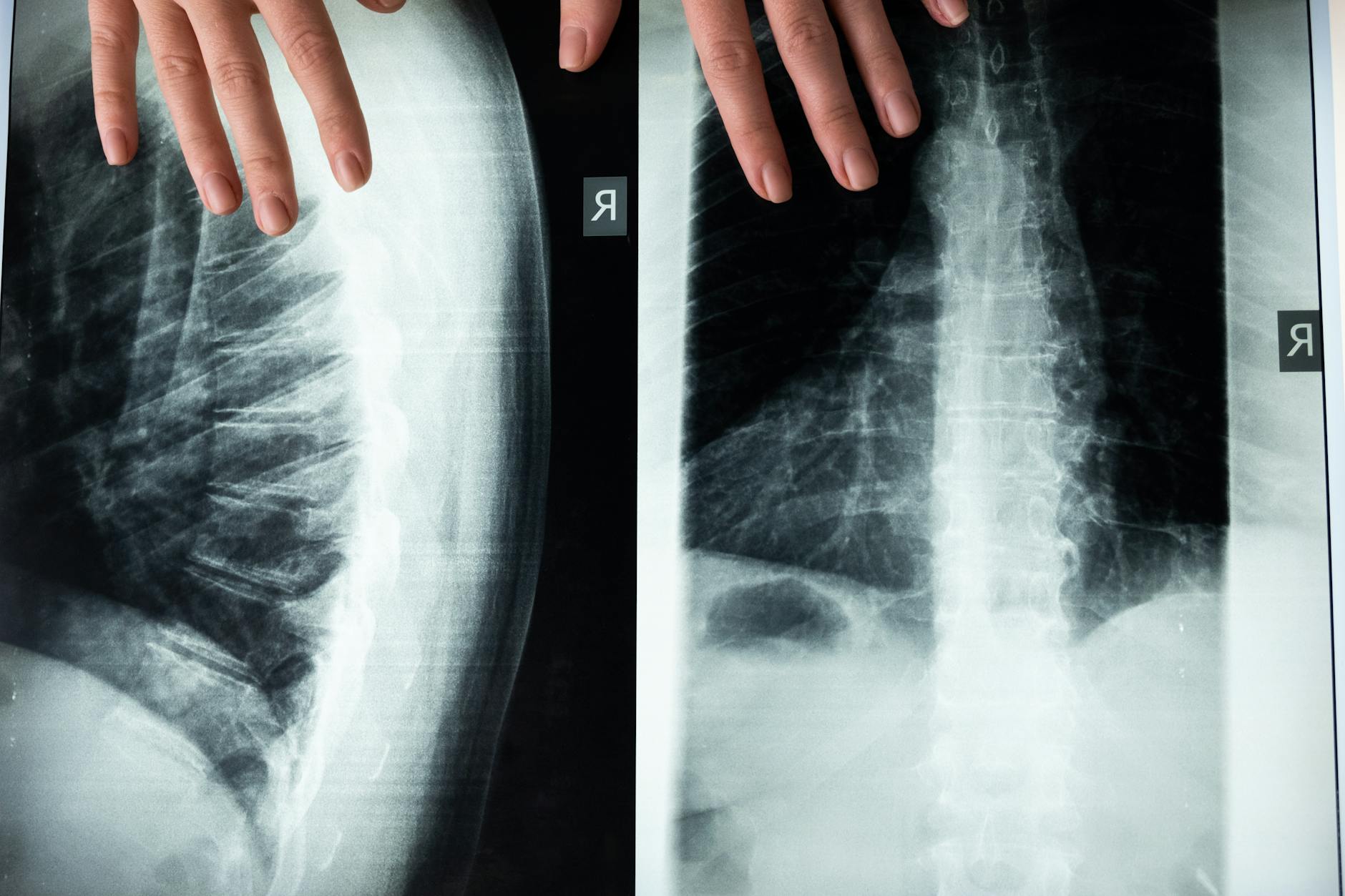
For a long stretch early in my career, I measured X-rays by hand.
I had a protractor, a ruler, a sharpened pencil, and a stack of films that I would hold up against the viewing box one at a time, late, after the lists were done. I was building a dataset for a paper. I got the consent forms signed. I explained to each patient, in a language they understood, what I was doing and why, and I let the ones who said no say no. I measured every angle myself because I did not trust anyone else to measure it the way it needed to be measured. It was slow, honest, unglamorous work, and I was proud of it in the quiet way you are proud of things nobody sees.
And in the same window of months, a man I knew — someone I had privately decided was not a serious clinician, pushy, the kind who steered patients toward the intervention that paid rather than the one they needed — published in a journal far better than the one I was struggling toward. He did it without, as far as I could tell, any of the care I was killing myself over. No hand-measured angles. No agonising over consent language. He just had the paper, and then he had another one.
I remember the exact feeling. A tightness, high in the chest, that I would not have called jealousy if you had asked me. Because I had a better word ready. Ethics. He cut corners. He used patients. The system rewarded the wrong man, and I was the one doing it properly. I told that story to myself so many times it became furniture. It took me years — and a pair of phrases I borrowed from the writer Justin Welsh and could not stop applying to surgeons — to admit what was actually happening in my chest that night.
I told myself it was about ethics. It wasn't. It was about me.
Justin Welsh calls it the asterisk reflex. When someone near you wins — the MCh seat, the fellowship, the paper, the senior's nod, the private referral that should have been yours — you instinctively go looking for the asterisk. He knew somebody. His uncle is a professor. He got lucky with that data. The intervention was unethical. You go looking for the footnote that shrinks their win down to a size you can live beside, and here is the cruel part: you always find one. You went looking. The reflex does not find the truth. It finds the asterisk you needed. And in the same motion, quietly, it reclassifies their success as your defeat — as if the two of you were drawing from one fixed pool, and every rupee in his column was a rupee stolen from yours.
You have done this. I know you have, because I have done it more times than I want to write down. You have read a batchmate's announcement post — the new position, the foreign fellowship, the forty-three likes and three seniors in the comments who have never once acknowledged you — and felt something arrive in your body that was not happiness. You searched for the asterisk before you had finished reading the sentence. And then, like me, you reached for a nobler word for it.
Naming a thing is the beginning of taking its power back, so let me name it plainly. The asterisk reflex is not a character flaw. It is a survival mechanism, and it is doing exactly what it was built to do.
Look at who is feeling it. You are two to seven years out of residency. You work sixty, eighty, sometimes a hundred hours a week. Your effective hourly rate, if you ever sat down and did the division, is lower than what you pay the man who drives you to the hospital. You are technically excellent and strategically invisible. You were trained for two decades to be measured against a single, individual standard — your complication rate, your numbers, your name on the operative note — in an environment where every outcome is attributed to one person and one person only. Put a human being under that much individual pressure, in that much scarcity, and surround them with peers being ranked on the same axis, and resentment is not a moral failing. It is the predictable output of the machine. The reflex is the bruise, not the sin.
I felt it first long before the radiology paper. Right after MBBS, sitting the postgraduate entrance, I watched people I had privately filed as weaker thinkers walk into the premier institutes ahead of me. I came from a strong science background, taught by people who prized reasoning over recall, and medicine's culture of rote memorisation always felt alien and slightly insulting to me. The entrance was multiple-choice — recall, not reasoning — and so, in my telling, the wrong people went through. They got more than they deserved. I got less.
It would take me a long time to allow the obvious correction. Those people worked hard in exactly the direction the exam demanded. They worked their backsides off to crack a test I considered beneath me, while I sat in judgement of the test and did not. But that correction came later. In the moment, the reflex did its job: it pointed my eyes sideways, at them, and kept them there.